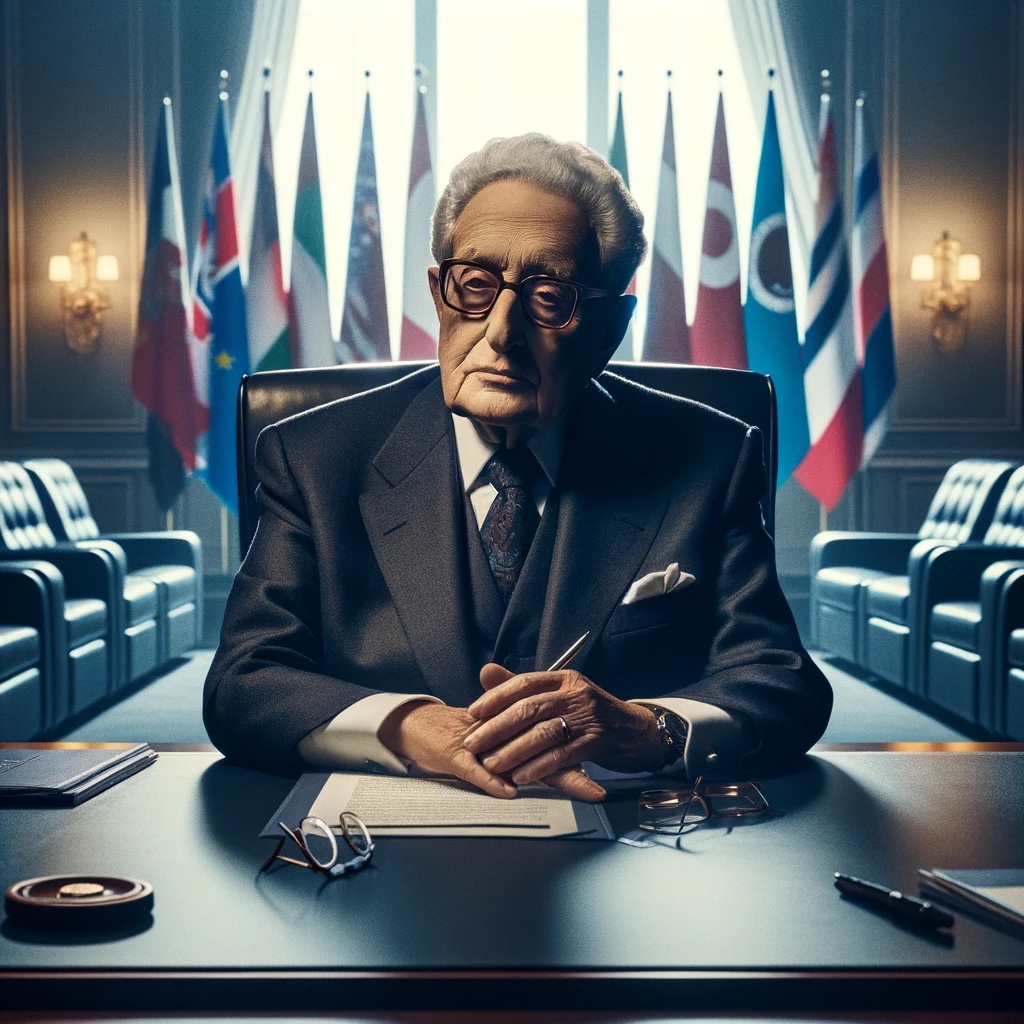
From John F. Kennedy until recently, every U.S. president has sought the counsel of Henry Kissinger (1923-2023), along with CEOs and political leaders from around the world. His views on foreign policy, State affairs, and world order have been much discussed. However, his remarkable world record as a negotiator has largely gone unnoticed, leading James K. Sebenius, Nicholas Burns and Robert H. Mnookin to author the book Kissinger, the Negotiator. Lessons from Dealmaking at the Highest Level. Sebenius is a professor with the Harvard Negotiation Project and wrote the book 3-d Negotiation: Powerful Tools to Change the Game in Your Most Important Deals.
Some negotiators prefer strategy and the big picture, whilst others focus on the emotion and empathy, and specific points. Few combine both positions. Sebenius et al. examine Kissinger’s uniquely developed ability to focus on a broader perspective. They characterise his approach as strategic, realistic, prone to change the game, and agile in multi-party situations.
Many people believe that negotiation is simply bargaining; it is not unlike a bazaar, where one person makes an extremely high offer and the counterpart keeps offering the same. Concessions are made gradually with the goal of bringing the parties to a final agreement. Kissinger characterised and criticised this standard approach to negotiation early in his career and later this was reflected in his negotiations: There is no point in moderating offers if the agreement is normally between two starting positions. Effective negotiation would propose a much more radical starting point than one is willing to accept. The more outrageous the initial offer, the clearer the idea of what one “really” wants to be considered a compromise.
Kissinger advised convincing the other side of one’s own underlying objectives and interests rather than exaggerating tactics. He argued that failure to do so hinders effective negotiation. In general negotiations, Kissinger expressed, “I made a considerable effort to leave no doubt of our fundamental approach. Only romantics think they can prevail in a negotiation by trickery: only pedants believe in the advantage of obfuscation. In a society of sovereign states, an agreement will only hold if all parties consider it in their interest. They must have a sense of participation in the result. The art of diplomacy is not to outsmart the other side, but to convince it either of common interest or of penalties if an impasse continues”. He continued “The wise diplomat understands that he cannot afford to trick his opponent; in the long run a reputation for reliability and fairness is an important assets. The same negotiators meet over and over again: their ability to deal with one another is undermined if a diplomat acquires a reputation of evasion or duplicity”.
It is evident that the realist in Henry Kissinger values actions and results rather than words: “Statesmen value the steadiness and reliability in a partner, not the restless quest for even-new magic formulas”. This brings us closer to a virtuous model, to maintain stable relationships over time, based on trust and reputation, than the Machiavellian model of short-term results.
Analysing the negotiations in which Kissinger was involved, the best contribution to more than 130 meetings between China and the United States in Warsaw was when an ambiguous and elegant formula that both parties could live with was achieved. This enabled the United States and China to cooperate on many other relevant issues. The crucial sentence is as follows:
“The United States acknowledges that all Chinese on either sides of the Taiwan Straits maintain that there is but one China. The United States Government does not challenge that position.”
Just words? Hardly. There have been countless examples of such creatively ambiguous formulations of Kissinger negotiations. The common denominator is always face-saving formulations, but they result in both sides declaring victory and being able to move forward from previous deadlocks.
In some cases, however, no word of the agreement may be too costly to pronounce or formalise in writing. These are tacit agreements. However, the constructively proposed agreement may be unacceptable if enforced.
These tacit agreements, in general, can be useful when there is a group of stakeholders, or a powerful audience, internal or external, that opposes a formal agreement and can impose costs on a negotiator who agrees to them. Without many of the possible costs, a tacit agreement can be based on the desired content, irrespective of its form.
Constructive ambiguity and tacit agreements have a privileged place in the tactical toolkit of Kissinger, the global negotiator.